
FMEA vs. RCFA: What’s the Difference and When Should You Use Each?
FMEA and RCFA are two widely used reliability tools, but they are designed to answer fundamentally different questions.
FMEA asks: What could fail, and what should we do about the risk?
RCFA asks: Why did this failure happen, and what should we change to prevent recurrence?
The distinction sounds simple. In practice, the two are sometimes treated as interchangeable—or applied at the wrong point in the equipment lifecycle.
A component fails, and someone requests an FMEA.
A new system is being designed, and the team waits until failures occur before systematically examining its risks.
Both situations can result from misunderstanding the purpose of the tools.
FMEA and RCFA can complement each other, but they are not substitutes for one another.
Understanding the difference helps reliability teams choose the right method for the problem they are trying to solve.
What Is FMEA?
FMEA stands for Failure Modes and Effects Analysis.
It is a structured method used to identify potential failure modes, understand their effects, evaluate associated risks, and determine whether actions are needed to reduce those risks.
The key word is potential.
An FMEA does not require the failure to have already occurred.
The team asks questions such as:
What function must this system or component perform?
How could that function fail?
What failure modes could produce that functional failure?
What would happen if the failure occurred?
What controls currently prevent or detect it?
Which risks require additional action?
FMEA is therefore primarily proactive.
It helps an organization anticipate credible failure scenarios before those failures create significant consequences.
A Simple FMEA Example
Consider an electric motor driving a sawmill conveyor.
One potential failure mode might be:
Component: Motor Bearing
Failure Mode: Wear
The team might then evaluate possible effects such as:
Local effect: Increased bearing clearance and vibration
Equipment effect: Motor vibration or eventual inability to rotate properly
Operational effect: Conveyor stops
Potential consequence: Production interruption
The FMEA can then consider existing controls and whether additional preventive, predictive, design, or operational measures are warranted.
The analysis begins with a potential failure—not necessarily an event that has already happened.
What Is RCFA?
RCFA stands for Root Cause Failure Analysis.
RCFA is used after an actual failure or undesirable event has occurred and the organization needs to understand why.
The investigation starts with evidence from a real event.
For example:
A conveyor stopped because its drive motor bearing failed.
That is not yet a root cause.
It identifies the failed component and perhaps the physical failure mode.
The investigation must continue.
Why did the bearing fail?
Inspection might reveal severe raceway damage.
Why did that damage develop?
Additional evidence might identify lubricant contamination.
Why was contamination entering the bearing?
Perhaps the investigation identifies an ineffective sealing arrangement, an improper lubrication practice, environmental contamination, or another underlying condition.
The analysis progressively moves from:
What happened?
↓
What failed?
↓
How did it fail?
↓
Why did it fail?
↓
What conditions allowed that cause to exist?
RCFA is therefore primarily reactive and investigative.
It uses evidence from an actual event to determine why that event occurred and what actions could prevent recurrence.
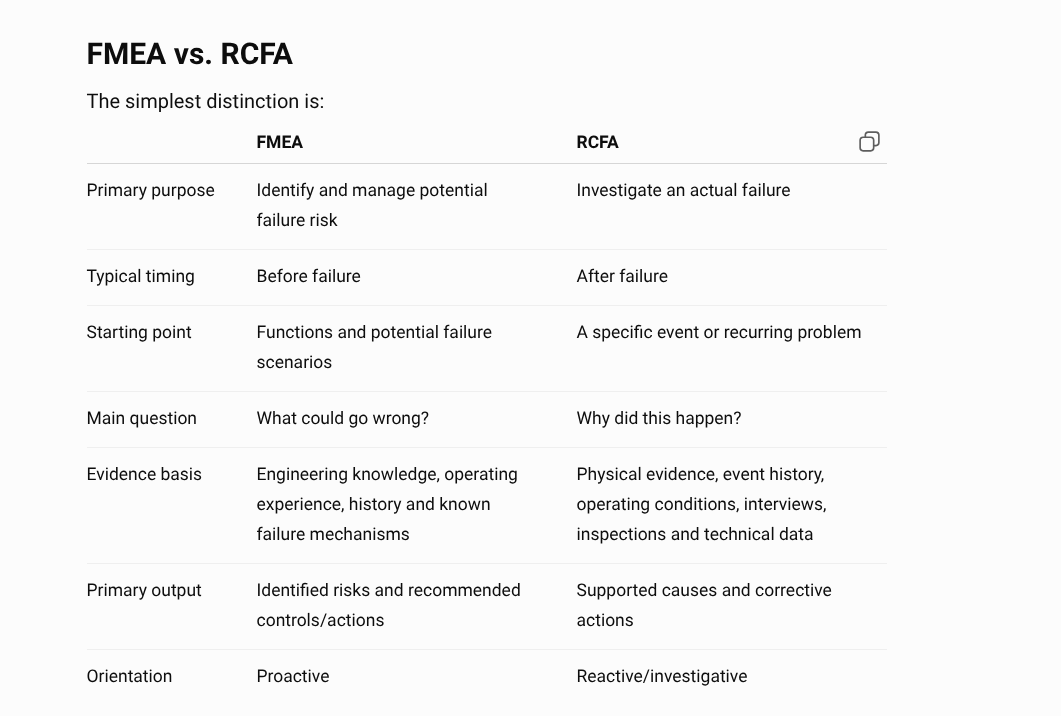
Neither approach is inherently better.
They solve different problems.
Failure Mode Does Not Mean Root Cause
One reason FMEA and RCFA can become confused is the term failure mode.
Suppose maintenance determines:
Failed Component: Bearing
Failure Mode: Spalled
That describes how the bearing physically failed.
It does not necessarily explain why it failed.
The underlying cause might involve:
contamination,
lubrication deficiency,
misalignment,
excessive loading,
incorrect installation,
improper fit,
electrical damage,
or another mechanism.
This distinction is important in both FMEA and RCFA.
An FMEA may identify bearing spalling as a credible failure mode and evaluate its potential effects and controls.
An RCFA may investigate a bearing that actually spalled and determine the specific conditions that produced the damage.
The same failure mode can therefore appear in both processes—but for very different reasons.
Should an FMEA Be Performed After Every Component Failure?
Usually, no.
Performing a complete FMEA every time an individual component fails would often be an inefficient use of the method.
A failed component may warrant troubleshooting, inspection, documentation, or some level of causal analysis without requiring a new FMEA.
The appropriate response depends on factors such as:
consequence of the event,
recurrence,
safety or environmental significance,
production impact,
repair cost,
uncertainty about the cause,
and whether the failure exposes a previously unrecognized risk.
If a bearing fails once because of a clearly identified installation error, the organization may not need to conduct an entirely new FMEA on the bearing.
If the event reveals that the existing FMEA failed to identify an important failure scenario, however, the FMEA should potentially be reviewed and updated.
That is an important distinction:
A failure can provide new information to an FMEA without requiring the organization to perform an FMEA from scratch.
Not Every Failure Requires a Full RCFA Either
The same principle applies to RCFA.
A formal root cause investigation requires time and resources.
Organizations typically need criteria for deciding which events justify that investment.
A formal RCFA may be appropriate for:
significant safety events,
major production losses,
high-cost failures,
environmental events,
repeated failures,
chronic equipment problems,
failures with unclear causes,
or events with potentially serious consequences.
A routine low-consequence failure with a well-understood cause may only require normal troubleshooting and documentation.
The goal should not be:
Perform an RCFA on everything.
The better question is:
Which failures justify deeper investigation?
That allows engineering and maintenance resources to be focused where they can create the most value.
FMEA Is About Risk, Not Just Making a Failure List
Another common misunderstanding is treating FMEA as a list of everything that can break.
A useful FMEA goes further.
The analysis connects:
Function
↓
Functional Failure
↓
Failure Mode
↓
Effect
↓
Consequence/Risk
↓
Existing Controls
↓
Recommended Action
This matters because two identical components can present very different risks depending on their application.
Consider two similar bearings.
One operates on a redundant auxiliary conveyor.
Another supports equipment whose failure immediately stops the primary production process.
The physical bearing failure modes may be similar.
The consequences of those failures are not.
FMEA helps the organization understand that distinction.
RCFA Is About Evidence, Not Brainstorming
RCFA has a different challenge.
Teams can easily move from evidence into speculation.
A bearing fails and someone says:
"It was probably lubrication."
Another person says:
"Those bearings are just poor quality."
Someone else remembers a previous alignment problem.
All may be reasonable hypotheses.
None is automatically a root cause.
A good investigation separates:
Observation
from
Diagnosis
from
Cause.
For example:
Observation: Operator reported excessive vibration.
Finding: Drive-end bearing was damaged.
Physical failure mode: Inner-race spalling.
Evidence: Damage morphology and supporting inspection data indicate abnormal loading.
Causal investigation: Determine what produced that loading condition.
That progression protects the investigation from jumping directly from a symptom to an unsupported conclusion.
Where Standardized Downtime Data Fits
FMEA and RCFA both become more useful when the organization has structured historical failure data.
Imagine trying to evaluate a potential bearing problem when historical downtime records say:
Mechanical
Bad bearing
Shaking
Drive problem
Won't run
Motor
Broken
There may be valuable information buried in those records, but identifying patterns is difficult because different types of information have been mixed together.
Now consider records structured as:
Equipment Unit → Subsystem → Observable Behavior → Failed Component → Failure Mode
For example:
Debarker 01 → Drive System → Excessive Vibration → Bearing → Spalled
Historical records can now help answer useful questions.
How frequently has this component failed?
Which failure modes recur?
What observable conditions have accompanied those events?
Are similar failures occurring on comparable equipment?
That information can support both FMEA and RCFA without replacing either one.
How Downtime Data Supports FMEA
FMEA depends partly on understanding credible failure scenarios.
Historical standardized data provides evidence about what has actually occurred in the operating environment.
Suppose an FMEA team believes coupling misalignment is possible but uncommon.
Historical records might show that misalignment-related coupling failures have occurred repeatedly across similar equipment.
That information could change how the team evaluates the failure scenario and its controls.
Downtime history can therefore help FMEA teams move beyond:
"What do we think could happen?"
toward:
"What does our operating history tell us is actually happening?"
Engineering judgment remains necessary, because historical data cannot identify every credible future failure.
But the history provides valuable evidence.
How Downtime Data Supports RCFA
The relationship with RCFA is even more direct.
Suppose a bearing fails today.
An investigator can examine the failed bearing, lubrication condition, alignment, operating environment, maintenance history, and other evidence.
But structured historical downtime data can also reveal whether the event is isolated or part of a larger pattern.
Perhaps the investigator discovers:
six similar bearing failures occurred during the previous year,
five involved the same subsystem,
excessive vibration preceded four events,
three had the same physical failure mode,
and repair durations have been increasing.
That history does not determine the root cause.
But it helps define the scope of the investigation and identify patterns worth examining.
FMEA and RCFA Should Feed Each Other
The strongest reliability systems do not treat FMEA and RCFA as isolated exercises.
Information can flow between them.
An FMEA identifies credible risks and establishes controls.
↓
Equipment operates.
↓
Failures and conditions are captured consistently.
↓
Significant or recurring events trigger RCFA.
↓
The investigation produces new knowledge.
↓
That knowledge is fed back into the FMEA.
↓
Risk controls, maintenance strategies, designs, or operating practices are updated where appropriate.
This creates a learning loop:
Anticipate → Operate → Observe → Investigate → Learn → Update
FMEA contributes proactive knowledge.
RCFA contributes event-derived knowledge.
Operational data connects the two.
An Example of the Complete Cycle
Consider a conveyor drive.
During an FMEA, the team identifies:
Component: Coupling
Potential Failure Mode: Misalignment-related wear
Potential Effect: Increased vibration and eventual loss of drive
Existing Control: Periodic alignment inspection
Months later, the conveyor experiences repeated coupling problems.
Downtime records consistently identify:
Observable Behavior: Excessive Vibration
Failed Component: Coupling
Failure Mode: Worn
Because the failures are recurring, the organization initiates an RCFA.
The investigation finds that the coupling is repeatedly becoming misaligned because the motor base is moving under operating load.
The corrective action addresses the mounting condition rather than repeatedly replacing couplings.
The FMEA can then be updated with the new knowledge.
The organization has moved from:
potential risk
to
observed failure
to
evidence-supported cause
to
improved risk control.
That is how the two methods can work together.
Choosing the Right Tool
When deciding whether you need FMEA or RCFA, start with the question you are trying to answer.
If the question is:
What could fail, what would happen, and how should we manage the risk?
Use FMEA.
If the question is:
This failure occurred. Why did it happen, and what should prevent it from happening again?
Use RCFA.
If a significant failure reveals a risk that was not adequately addressed previously, you may ultimately use both:
RCFA to understand the event.
Then FMEA review to incorporate what was learned into future risk management.
The Bottom Line
FMEA and RCFA are complementary reliability methods, but they serve different purposes.
FMEA is proactive. It examines potential failure scenarios and helps organizations manage risk before those failures occur.
RCFA is investigative. It examines actual failures and uses evidence to determine why they occurred and what should change.
Neither method should become a procedural checkbox.
Not every failed component requires a new FMEA.
Not every equipment stoppage requires a formal RCFA.
The value comes from applying the right level of analysis to the right problem—and preserving what the organization learns.
When FMEA, RCFA, and standardized failure data work together, reliability teams can create a continuous learning system:
anticipate risk, capture what actually happens, investigate significant failures, and use those findings to make the system stronger.
