
Preventive Maintenance vs. Predictive Maintenance: What’s the Difference?
Maintenance strategies are often discussed as if one approach should replace another.
Preventive maintenance is sometimes described as outdated, while predictive maintenance is presented as the more advanced solution.
In practice, the decision is more nuanced.
Preventive maintenance and predictive maintenance solve different problems.
A strong maintenance program does not necessarily choose between them. It determines where each strategy is technically appropriate, economically justified, and capable of reducing risk.
Understanding the difference starts with a simple question:
What triggers the maintenance action?
What Is Preventive Maintenance?
Preventive maintenance, often abbreviated as PM, is maintenance performed at predetermined intervals or according to prescribed criteria to reduce the probability of failure or degradation.
The trigger is typically time or usage.
Examples include:
Replacing a component every six months
Inspecting a gearbox every 1,000 operating hours
Lubricating a bearing every two weeks
Changing filters at scheduled intervals
Inspecting belts during a monthly PM
Replacing a wear component after a specified number of cycles
The equipment does not necessarily need to show evidence of impending failure.
The maintenance activity occurs because the predetermined interval or criterion has been reached.
A simple example
Suppose a manufacturer recommends replacing a filter every three months.
The filter may still be functional when it is replaced.
The maintenance action is triggered by the schedule, not by evidence that the filter is approaching failure.
That is preventive maintenance.
What Is Predictive Maintenance?
Predictive maintenance uses information about the actual condition of equipment to help determine when maintenance should be performed.
Instead of asking:
“Is it time to perform this task?”
predictive maintenance asks:
“What is the condition of the asset telling us?”
Information may come from technologies such as:
Vibration analysis
Oil analysis
Infrared thermography
Ultrasound
Motor current analysis
Temperature monitoring
Pressure or flow monitoring
Online condition-monitoring systems
Other measurable indicators of equipment condition
The objective is to identify developing degradation early enough to plan an appropriate response.
A simple example
Consider a critical motor bearing.
A preventive strategy might specify replacing or inspecting the bearing after a predetermined interval.
A predictive approach could instead monitor vibration trends.
If vibration characteristics begin indicating a developing bearing defect, the organization can investigate and plan the repair based on the equipment's condition.
The maintenance decision is therefore driven by condition, rather than simply by the calendar.
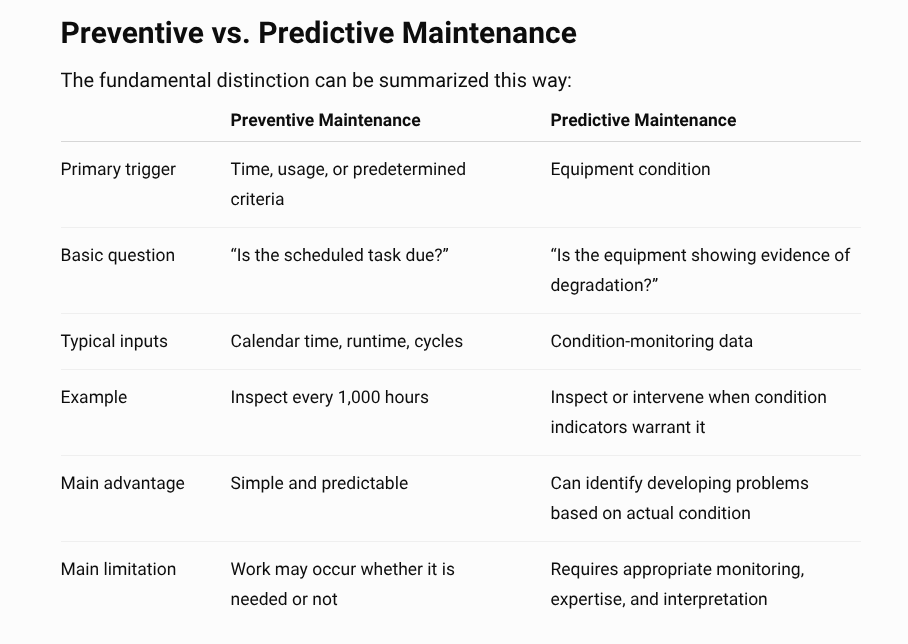
Neither column is inherently better.
The correct strategy depends on the failure mechanism, consequences, detectability, operating environment, economics, and available monitoring capability.
The Problem With “More Predictive Is Better”
Predictive maintenance sounds attractive because it appears to eliminate unnecessary scheduled maintenance.
But not every failure can be effectively predicted.
For predictive maintenance to be useful, there generally needs to be a detectable change in condition that occurs early enough to provide meaningful warning before functional failure.
Consider two different failure scenarios.
Scenario A: Progressive bearing degradation
A bearing develops a defect that produces measurable vibration characteristics before functional failure.
Condition monitoring may provide useful warning.
Predictive maintenance may be appropriate.
Scenario B: Sudden electronic failure
An electronic component fails suddenly with little or no practical detectable warning.
Adding vibration analysis or thermography simply because the organization wants a “predictive maintenance program” may provide little value.
The strategy should follow the failure behavior, not the maintenance trend of the moment.
Preventive Maintenance Has Its Own Limitations
Preventive maintenance can also be misapplied.
A common assumption is:
“If failures are occurring, we need more PMs.”
That can result in maintenance programs filled with repetitive tasks that consume labor without meaningfully reducing risk.
Some scheduled tasks may:
Find nothing
Address failure modes that are not age-related
Be performed more frequently than necessary
Introduce opportunities for maintenance-induced problems
Consume resources that could be directed toward higher-value work
This doesn't mean preventive maintenance is ineffective.
It means every preventive task should have a reason to exist.
A useful question is:
What failure mode is this task intended to prevent, detect, or mitigate?
If that question cannot be answered, the task deserves further examination.
When Preventive Maintenance Makes Sense
Preventive maintenance can be particularly useful when there is a technically defensible relationship between the maintenance interval and the failure mechanism or when periodic servicing is required.
Examples can include:
Lubrication tasks
Components requiring periodic replenishment or replacement of lubricant may need scheduled servicing.
Wear components
Certain components may have reasonably understood wear characteristics that support scheduled inspection or replacement.
Regulatory or safety inspections
Some inspections must occur at specified intervals regardless of apparent equipment condition.
Routine servicing
Filters, consumables, adjustments, and other service requirements may lend themselves to predetermined intervals.
The important point is that the interval should be based on something more meaningful than:
“We've always done it every month.”
When Predictive Maintenance Makes Sense
Predictive maintenance becomes especially valuable when a developing failure produces a measurable condition that can be detected with sufficient warning.
Rotating equipment is a common example.
A condition-monitoring program may identify indications associated with:
Bearing degradation
Misalignment
Imbalance
Mechanical looseness
Lubrication-related problems
Certain gear defects
But collecting condition data alone does not create predictive maintenance.
Someone must be able to interpret the information, determine its significance, and translate it into an appropriate maintenance decision.
A sensor attached to a machine is not a maintenance strategy.
Predictive Maintenance Is Not the Same as Condition Monitoring
These terms are often used interchangeably, but there is an important distinction.
Condition monitoring generates information.
Predictive maintenance uses condition information to support maintenance decisions.
A facility can collect enormous amounts of vibration, temperature, oil, and sensor data without actually improving reliability.
The value appears when the organization can turn:
Measurement → Detection → Interpretation → Decision → Action
If the process stops at measurement, the organization has created more data—not necessarily better maintenance.
You Don't Have to Choose One
A mature maintenance strategy can use several approaches simultaneously.
One machine may have:
Scheduled lubrication
Periodic inspections
Online vibration monitoring
Operator inspections
Planned replacement of a specific wear component
Run-to-failure decisions for low-consequence components
That is not contradictory.
Different failure modes can require different maintenance strategies—even within the same equipment unit.
This is why assigning a single label such as “predictive asset” or “preventive asset” can oversimplify the decision.
Maintenance strategy should ultimately address how the equipment can fail and what should be done about those failures.
Where Maintenance Data Becomes Important
There is another part of the preventive-versus-predictive discussion that receives less attention:
How do you know whether your strategy is actually working?
You need reliable history.
If maintenance records contain entries such as:
Mechanical
Fixed
Checked
Repaired
Other
Bad bearing
Equipment problem
it becomes difficult to determine which failure modes are recurring and whether the maintenance strategy is addressing them.
Good maintenance strategy depends on being able to connect information such as:
Asset → Failure → Maintenance activity → Result
Without consistent equipment identities, work histories, and failure information, organizations can end up optimizing maintenance strategies based more on perception than evidence.
This is why maintenance data quality and maintenance strategy are closely connected.
A Better Question Than “Which Is Better?”
Instead of asking:
“Should we use preventive or predictive maintenance?”
ask:
“What failure are we trying to manage, and what is the most effective way to manage it?”
For one failure mode, the answer may be scheduled replacement.
For another, it may be vibration monitoring.
For another, an operator inspection may be sufficient.
And for another, allowing the component to run to failure may be the most rational decision.
The maintenance strategy should fit the failure—not the other way around.
Final Thoughts
Preventive and predictive maintenance are not competing philosophies.
They are tools.
Preventive maintenance acts according to predetermined intervals or criteria.
Predictive maintenance uses equipment-condition information to help determine when intervention is appropriate.
Both can provide substantial value when applied to the right failure mechanisms, and both can waste resources when applied without understanding what they are intended to accomplish.
The goal isn't to have the most PMs.
It isn't to install the most sensors.
And it isn't to call your maintenance program “predictive.”
The goal is to understand how your equipment fails, detect or prevent the failures that matter where technically feasible, and make maintenance decisions using reliable information.
Better maintenance isn't about choosing the most advanced strategy. It's about choosing the right strategy for the failure you're trying to manage.
