
Observable Behaviors Explained: The Missing Link Between Downtime and Root Cause
When a machine goes down, operators often describe what they experienced before maintenance arrives.
"The conveyor was vibrating."
"The pump was making a grinding noise."
"The motor wouldn't start."
These observations are valuable—but they're often confused with failed components or failure modes. As a result, maintenance data becomes inconsistent, making it harder to identify trends, prioritize improvements, and perform effective root cause analysis.
Understanding observable behaviors helps create a common language for describing equipment problems and bridges the gap between what operators see and what maintenance technicians eventually diagnose.
What Is an Observable Behavior?
An observable behavior is the visible or measurable way equipment behaves when it is no longer performing as intended.
Unlike a failed component or failure mode, an observable behavior describes what can be observed—not why it happened.
Examples include:
Excessive Vibration
Abnormal Noise
Overheating
Failed to Start
Failed to Stop
Leaking
Restricted Movement
Jerking
Binding
Alarmed/Tripped
These behaviors can usually be identified by an operator without disassembling the equipment or diagnosing the underlying failure. This is one of the most common sources of confusion in maintenance data.
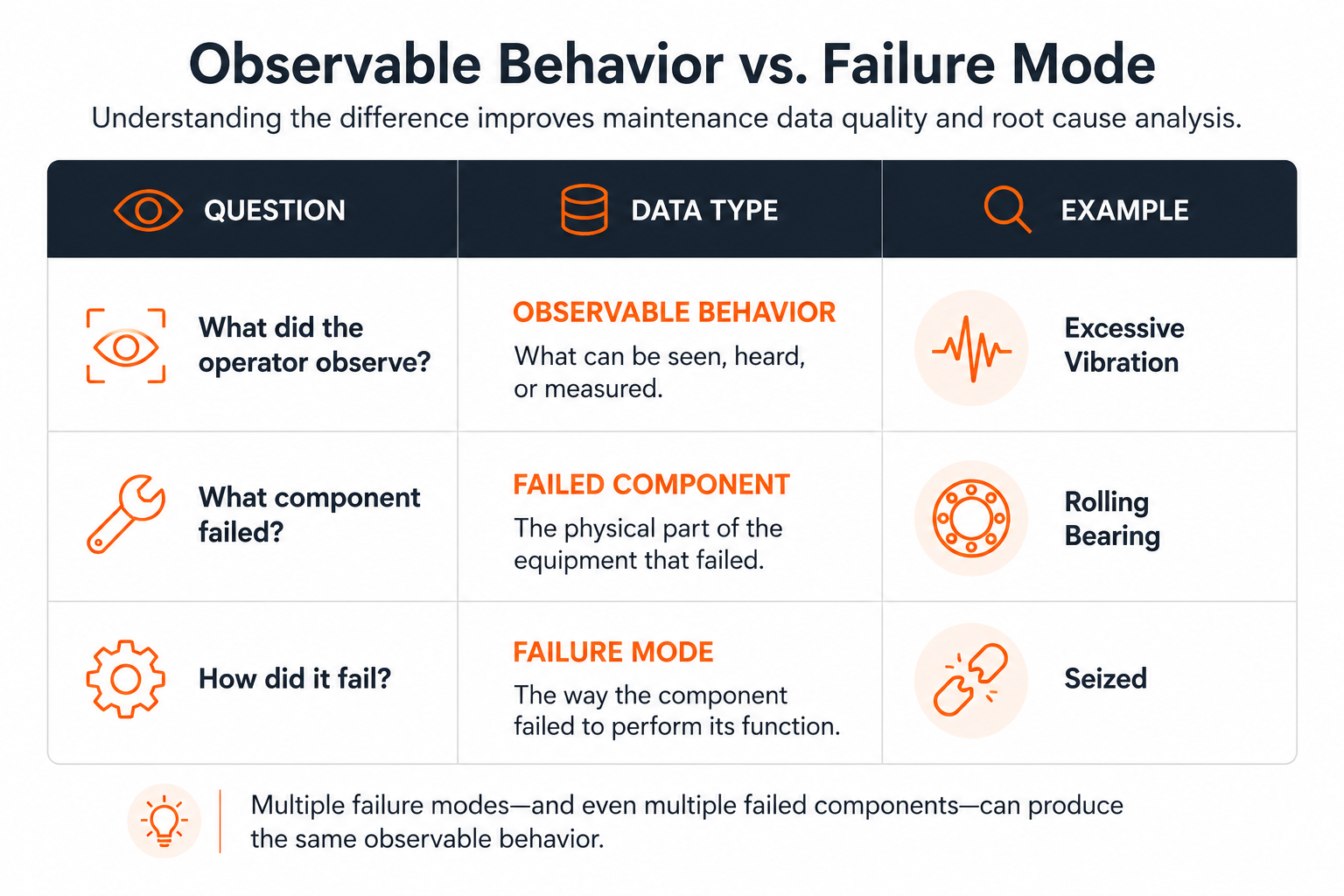
Comparison table showing the difference between observable behavior, failed component, and failure mode using excessive vibration, rolling bearing, and seized as examples.
Notice that multiple failure modes—and even multiple failed components—can produce the same observable behavior.
For example:
Observable Behavior: Excessive Vibration
Possible Failed Components:
Rolling Bearing
Coupling
Drive Shaft
Electric Motor
Gear Reducer
Possible Failure Modes:
Worn
Misaligned
Broken
Loose
Seized
If operators record "Bearing Failed" every time they hear vibration, valuable diagnostic information is lost because the actual failed component hasn't been confirmed yet.
Why Observable Behaviors Matter
Recording observable behaviors separately provides several important benefits.
Better Data Quality
Operators can consistently record what they actually observe instead of trying to diagnose the problem.
This reduces inconsistent entries like:
Bearing Bad
Gearbox Broken
Motor Issue
Pump Failure
Instead, operators select standardized observations such as:
Abnormal Noise
Excessive Vibration
Failed to Start
Maintenance technicians can later identify the failed component and failure mode after inspection.
Faster Root Cause Analysis
Observable behaviors provide important clues during investigations.
If several different assets repeatedly experience Excessive Vibration, engineers can investigate common causes such as:
Misalignment
Poor installation
Foundation issues
Lubrication practices
Operating conditions
Without standardized behaviors, those patterns are much harder to identify.
More Reliable Reporting
When every operator uses different wording, reporting becomes fragmented.
For example:
Loud Noise
Grinding
Making Noise
Sounds Bad
Squealing
All describe similar symptoms but appear as separate categories in reports.
Standardized observable behaviors eliminate this inconsistency and produce cleaner dashboards and Pareto charts.
Observable Behaviors Are Not Diagnoses
One of the biggest mistakes organizations make is expecting operators to diagnose failures.
Operators should record:
✔ What they observed
Maintenance technicians determine:
Failed component
Failure mode
Root cause
Separating these responsibilities improves both data quality and diagnostic accuracy.
A Practical Example
Imagine a conveyor suddenly stops moving.
Operator Records
Equipment: Transfer Conveyor
Observable Behavior: Failed to Start
After troubleshooting, maintenance discovers:
Failed Component: Motor Starter
Failure Mode: Contacts Welded Closed
Weeks later, another conveyor also won't start.
This time the diagnosis is:
Failed Component: Electric Motor
Failure Mode: Open Circuit
Although the observable behavior was identical, the underlying failures were completely different.
Capturing each data element separately preserves valuable information for future analysis.
Best Practices for Observable Behaviors
An effective observable behavior library should be:
Simple enough for operators to use consistently.
Broad enough to apply across many equipment types.
Independent of specific components.
Independent of failure modes.
Mutually exclusive whenever practical.
Based only on what can be observed or measured.
The goal is consistency—not complexity.
How Reliability Intelligence Solutions Helps
Reliability Intelligence Solutions develops standardized Observable Behavior Libraries that integrate with equipment hierarchies, failed component libraries, and failure mode libraries.
Rather than asking operators to diagnose equipment failures, these libraries provide a consistent set of observable behaviors that improve maintenance data quality while supporting better reliability analysis, root cause investigations, and CMMS reporting.
Final Thoughts
Every equipment failure begins with something someone notices.
By separating observable behaviors from failed components and failure modes, organizations capture cleaner, more consistent maintenance data without asking operators to make technical diagnoses.
The result is a stronger foundation for reliability engineering, more meaningful performance reporting, and better-informed maintenance decisions.
