
Downtime Reason Codes Explained: The Foundation of Meaningful Maintenance Data
Every maintenance organization records downtime.
But not every organization captures useful downtime data.
When downtime reason codes are inconsistent, overly generic, or interpreted differently by each operator, reports become unreliable and improvement efforts lose focus. The result is poor data quality, misleading Pareto charts, and missed opportunities to improve equipment reliability.
A well-designed downtime reason code system provides the structure needed to turn everyday maintenance events into meaningful reliability intelligence.
What Are Downtime Reason Codes?
A downtime reason code is a standardized way of recording why equipment stopped producing or operating as expected.
Rather than relying on free-text descriptions, operators select predefined categories that consistently describe what occurred during a downtime event.
For example, instead of entering:
"Bearing bad"
"Motor issue"
"Conveyor acting up"
"Gearbox problem"
a structured downtime record captures separate pieces of information, such as:
Equipment
Observable Behavior
Failed Component
Failure Mode
Downtime Duration
Work Order
Each field answers a different question, creating data that is far more useful for analysis.
Why Downtime Reason Codes Matter
Every downtime event tells a story.
Without standardized reason codes, those stories become difficult to compare.
Imagine three operators recording the same problem:
Operator A:
Loud bearing noise
Operator B:
Conveyor vibrating
Operator C:
Motor making noise
Although they may all describe the same underlying issue, they appear as three different categories in reports.
Standardized downtime reason codes eliminate this inconsistency by giving everyone the same language.
Good Downtime Codes Describe Different Things Separately
One of the most common mistakes is combining multiple pieces of information into a single reason code.
For example:
Motor Bearing Failed
Gearbox Seal Leak
Hydraulic Pump Broken
Each code combines:
Equipment
Component
Failure Mode
This makes reporting difficult because each code represents several different data elements.
Instead, reliability organizations separate the information.
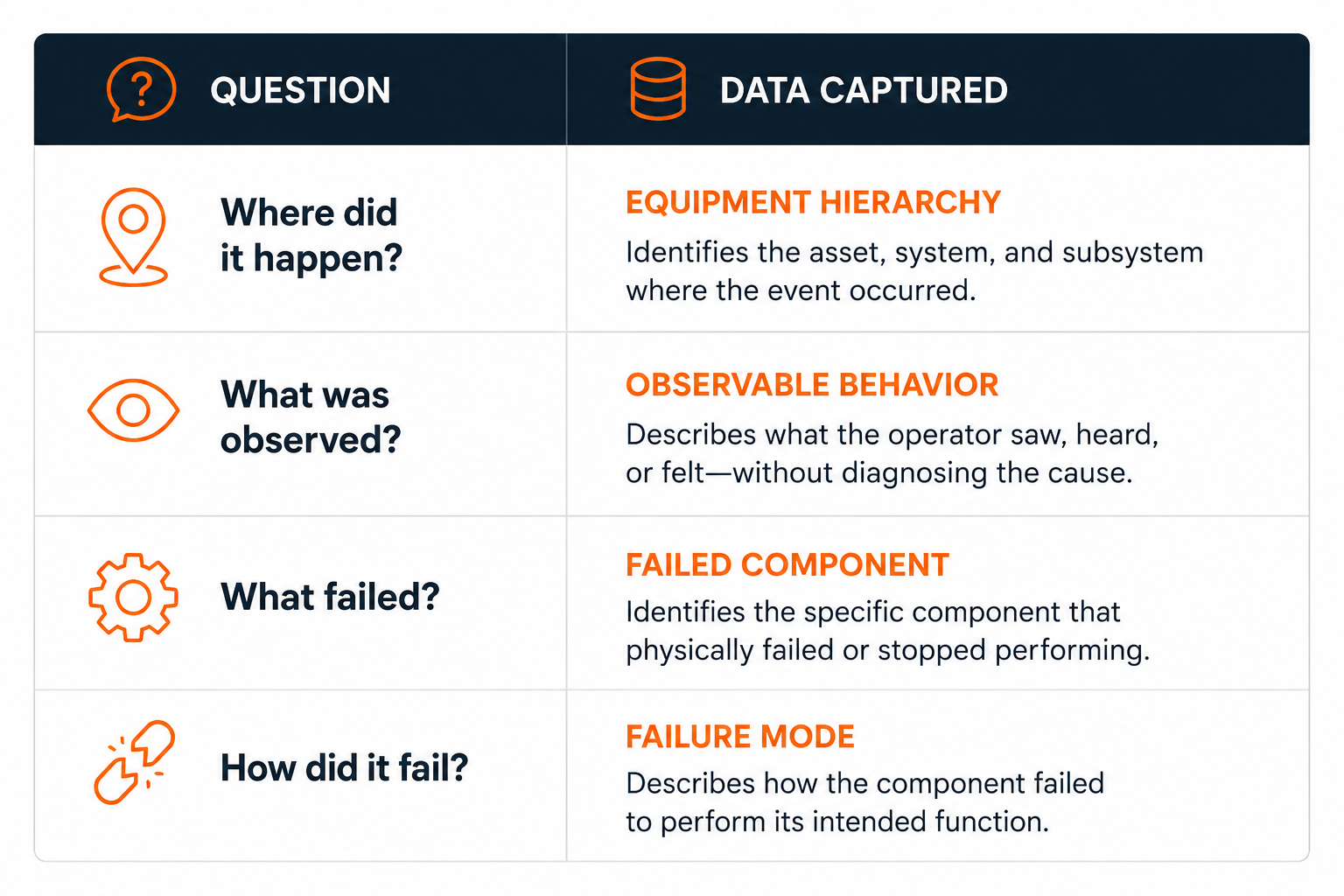
This structure allows the same data to be analyzed from multiple perspectives without creating thousands of unique reason codes.
Characteristics of Effective Downtime Reason Codes
An effective coding system should be:
Standardized
Everyone records downtime using the same terminology.
Simple
Operators should not need to diagnose failures.
They should record what they observe.
Consistent
Each reason code should have one clear meaning.
Avoid overlapping categories that create uncertainty.
Scalable
The system should work equally well for one machine or an entire facility.
Actionable
The information collected should support maintenance planning, reliability analysis, and continuous improvement.
Common Mistakes
Many organizations unintentionally reduce the value of their maintenance data by creating downtime codes that are inconsistent or overly detailed.
Common problems include:
Mixing Symptoms and Causes
Examples:
Bearing Failure
Excessive Vibration
Conveyor Jam
Each represents a different type of information.
They should not exist in the same list.
Free-Text Entries
Allowing operators to type descriptions often produces hundreds of variations.
Examples:
Bearing Bad
Bad Bearing
Noisy Bearing
Bearing Making Noise
Loud Bearing
Although they describe similar events, reports treat them as different categories.
Too Many Codes
Some organizations create thousands of unique downtime codes.
Operators struggle to find the correct option, leading to inconsistent selections.
Well-designed systems focus on standardized building blocks instead of endlessly expanding code lists.
Better Downtime Data Leads to Better Decisions
Reliable maintenance decisions depend on reliable maintenance data.
When downtime records are standardized, organizations can:
Identify recurring equipment problems.
Build accurate Pareto charts.
Improve maintenance planning.
Support root cause analysis.
Measure reliability trends.
Improve CMMS reporting.
Prioritize improvement projects with confidence.
Better data doesn't guarantee better decisions—but it gives teams a much stronger foundation for making them.
How Reliability Intelligence Solutions Helps
Reliability Intelligence Solutions develops standardized downtime reason code frameworks that separate equipment hierarchies, observable behaviors, failed components, and failure modes into structured, reusable libraries.
Rather than replacing your CMMS, these frameworks provide the standardized data structure that helps organizations collect more consistent maintenance information, improve reporting, and build a stronger foundation for reliability engineering.
Final Thoughts
Downtime reason codes are more than labels—they are the language your organization uses to describe equipment failures.
When that language is standardized, maintenance data becomes easier to understand, compare, and analyze.
The result is cleaner reporting, more meaningful reliability metrics, and better-informed maintenance decisions.
